22 AUGUST 2026
Telangana’s EV Charging Load Tripled. Check Your Building’s Electrical Capacity.
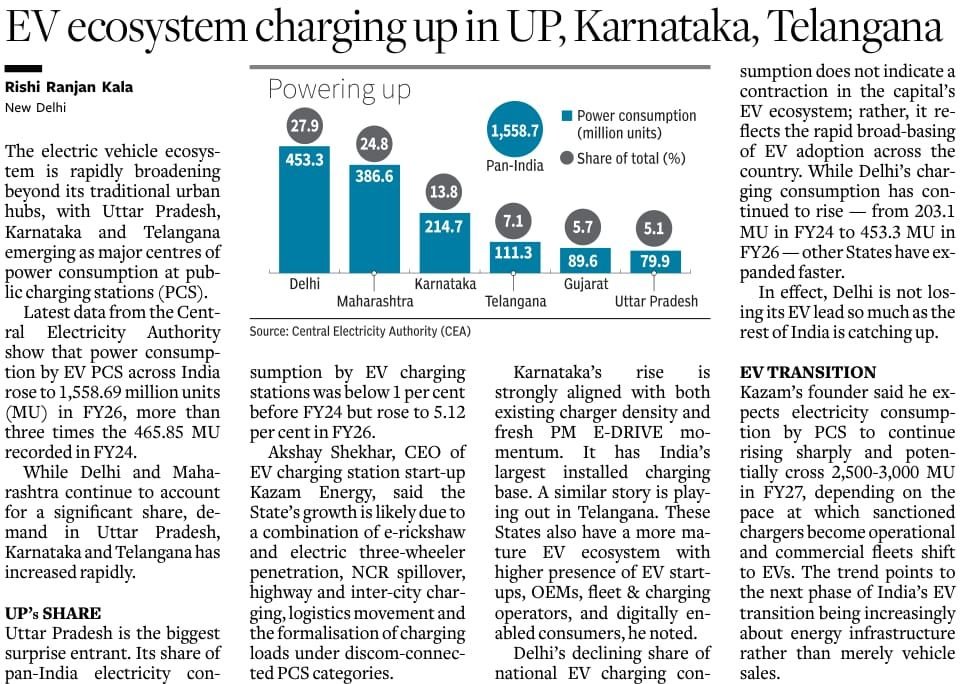
Public EV charging stations across India consumed 1,558.69 million units of power in FY26, up from 465.85 MU in FY24 — more than triple in two years, according to Central Electricity Authority data. Telangana accounted for 111.3 MU of that, or 7.1% of the national total.
Most coverage of this will file it under clean energy. For property owners it belongs in a different folder, because the fastest-moving risk in Indian residential real estate right now is buildings that cannot supply enough power to the parking level.
The state numbers
| State | FY26 consumption | National share |
|---|---|---|
| Karnataka | 214.7 MU | 13.8% |
| Telangana | 111.3 MU | 7.1% |
| Gujarat | 89.6 MU | 5.7% |
| Uttar Pradesh | 79.9 MU | 5.1% |
| Pan-India | 1,558.69 MU | — |
Of the states listed, Telangana sits second, though Karnataka is running at nearly double the volume. Several large states aren’t in this breakdown, so this isn’t a full ranking — but 7.1% of national charging load from a state with roughly 2.5% of India’s population is a meaningful over-index.
The growth rate is the more striking figure. Tripling in two years works out to roughly 83% annual growth. Infrastructure planning cycles in real estate do not move at 83% a year.
What this actually means for a residential buyer
Here is the practical translation, and it’s the reason this data matters more than it looks.
Public charging is the visible part of EV infrastructure, but it’s the minority of actual charging. Most EV owners charge at home, overnight, in their own parking slot. Which means the demand curve shown in this CEA data has a much larger shadow running through residential buildings — apartment complexes drawing power at the basement level, at scale, every night.
An apartment complex has a sanctioned electrical load. It was calculated when the building was designed, based on assumptions about how much power each flat would draw. Those assumptions almost certainly did not include a 7 kW charger per parking slot running for six hours a night across a meaningful share of residents.
So when you are evaluating a project, “EV charging available” on the amenities list is not the question. The questions are:
- What is the building’s sanctioned load, and how much headroom does it have?
- Is there provisioning to every parking slot, or a handful of shared charging bays?
- Has the electrical infrastructure — transformer capacity, cabling, distribution boards — been specified with EV load in mind?
- If demand grows, what does upgrading cost, and who pays?
Ask a developer these and you will learn quickly how seriously the building has been designed.
The obsolescence angle for existing stock
This is where the investment implication sits.
Retrofitting an older apartment complex for meaningful EV charging is expensive and awkward. It typically requires an enhanced power sanction, transformer upgrades, new cabling to the parking levels and a metering arrangement so that individual owners pay for their own consumption. It also requires the residents’ association to agree to spend the money, which in a building with a mix of EV owners and non-owners is frequently where the whole thing stalls.
The consequence is a slow divergence. New projects being built with EV-ready electrical infrastructure hold an advantage over ten-year-old stock in the same location that can’t easily provide it. That gap doesn’t show up in today’s prices. It shows up when a buyer with an EV walks through both and only one of them works for them.
If you own an older apartment in a good location, this is worth raising with your association now rather than in five years, when the cost is the same and the competitive disadvantage has already been priced in.
The commercial side
For commercial property owners the logic runs the other way — charging is a footfall and tenancy asset rather than a liability.
Malls, office parks and hotels that provide reliable charging give EV drivers a reason to choose them over alternatives, and dwell time while charging has obvious value in retail. Office landlords increasingly find charging on the specification list from corporate tenants with fleet or employee-benefit EV programmes.
There is also a small but real land use here. Public charging hubs need modest parcels with good road access and adequate power supply. Plots that are awkward for conventional development — narrow frontage, small area, high-traffic corridor — sometimes suit this use well.
What the data doesn’t tell you
A few limits worth respecting.
Power consumption is not the same as charging points, and neither is the same as EV penetration. A state with fewer, busier fast chargers can post higher consumption than one with more idle slow chargers.
This covers public charging only. Home and captive fleet charging sit outside it, and home charging is likely the larger volume — which is precisely why the residential infrastructure point matters more than the headline number.
And the article attributes Telangana’s position to its EV ecosystem of start-ups, OEMs, fleets and charging operators. Fleet charging in particular can concentrate a lot of consumption in relatively few locations, so this figure may reflect commercial vehicle activity as much as private ownership.
Frequently asked questions
How much power did EV charging stations consume in India in FY26? 1,558.69 million units, up from 465.85 MU in FY24 — more than three times in two years, per Central Electricity Authority data.
How much did Telangana consume? 111.3 MU, which is 7.1% of the national total.
Which state leads in EV charging consumption? Among the states in this data, Karnataka leads with 214.7 MU, or 13.8% of the national total.
Why is Telangana’s EV charging growing? The state’s EV ecosystem — start-ups, OEMs, fleet operators and charging companies — has developed relatively early, concentrating both vehicles and charging infrastructure.
What should apartment buyers check regarding EV charging? Sanctioned electrical load and available headroom, whether provisioning reaches individual parking slots or only shared bays, transformer and cabling capacity, and who bears the cost of future upgrades.
Can older apartment buildings add EV charging? Usually yes, but it can require an enhanced power sanction, transformer upgrades, new cabling and association approval — which makes it costly and slow compared with a building designed for it from the start.
Does EV charging capacity affect property value? Increasingly. It doesn’t show up in headline prices yet, but as EV ownership rises, buildings that can’t support home charging face a growing disadvantage against newer stock in the same location.
Evaluating a Hyderabad project?
Electrical provisioning is one of several things that separate a well-built project from a well-marketed one — and it rarely appears in the brochure. For a proper assessment before you commit, get in touch.
HydRealtyPro — 6281648087 Join our WhatsApp channel for Hyderabad real estate updates: https://whatsapp.com/channel/0029VaQtqi9KLaHgaw6FkY28
Figures are reproduced from the sources named in the note above and are indicative. Verify any project figure against its TG RERA registration and the sanctioned plan before acting on it.
More market notes
-
22 AUGUST 2026
Amazon Picked Hyderabad Over Bengaluru. That’s the Story.
Amazon has chosen Hyderabad for India's first permanent AWS Builder Loft — a community space for developers and students, with workshops, hackathons, co-working areas and event facilities,…
-
22 AUGUST 2026
Guidehouse’s 1,000 Hyderabad Jobs: Doing the Property Maths
Guidehouse, the US professional services firm, has opened a new hub in Hyderabad and expects to create more than 1,000 jobs over the next twelve months. The work will span managed services,…
-
22 AUGUST 2026
Proofpoint Is Adding 200+ Jobs in Hyderabad. Here’s What It Means for Property.
Proofpoint, the American cybersecurity firm, is expanding in Hyderabad with a new Security Engineering Centre and more than 200 new roles. The centre is being set up as a Centre of…